

Hi there,
Before I start, I want to share some exciting news: I am resuming The Matriark Salon starting this Fall. The gatherings will come in different forms and sometimes with different names, and I can’t wait to send you the invitations. More soon!

I met Meredith Burns years ago in the Hamptons, the way so many friendships begin — through our kids’ school, standing at pickup. I didn’t know that our school small talks were going to turn into something that completely changed how I take care of myself and my family.
Fast forward to 2023. My father started showing the signs of dementia. Repeated questions. A story told several times over in one sitting.
Almost two-thirds of Americans living with Alzheimer’s are women
While I was learning about dementia, Meredith was living a version of it three times over. In twenty-four months, she lost three members of her family to different variations of the same disease. But Meredith, being the force that she is, did not let her incredible grief break her. She channelled it into fuel instead, and I am so grateful for it.
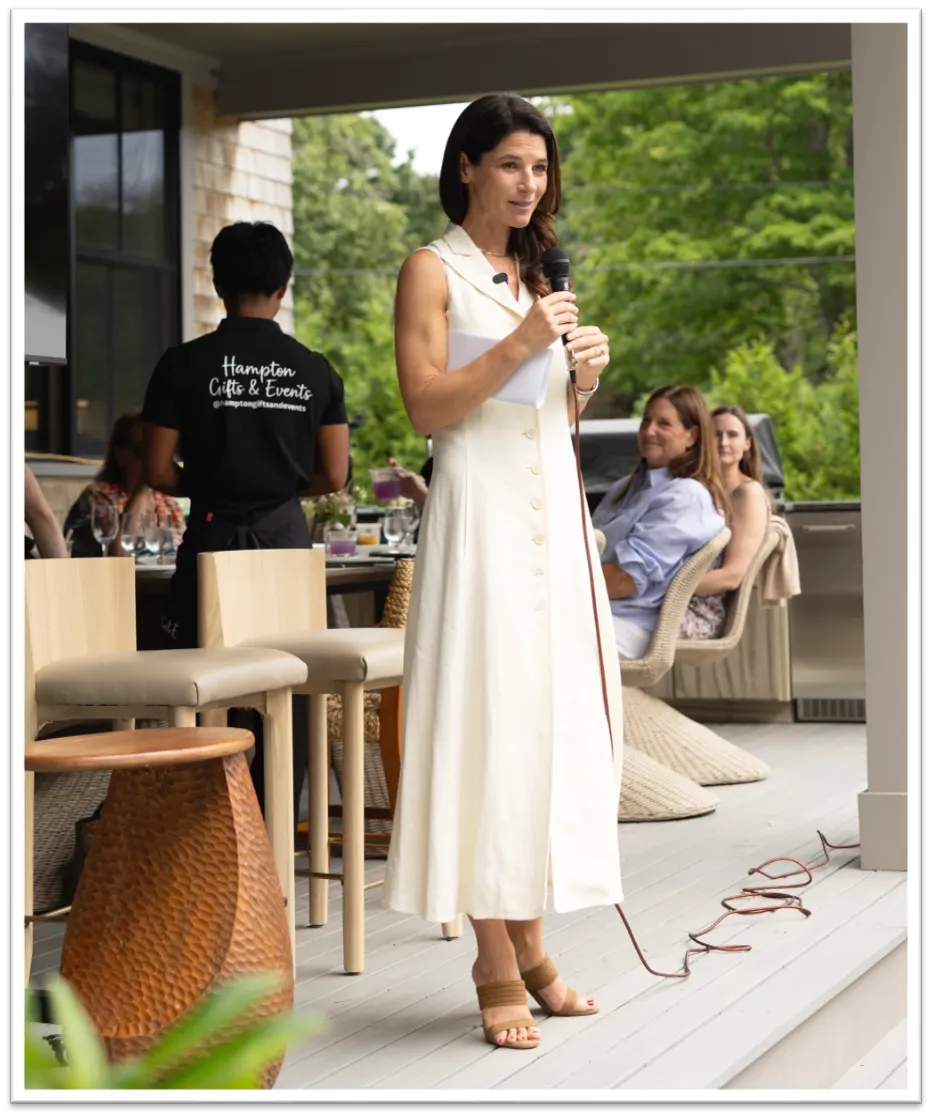
Ten days ago, Meredith hosted a beautiful luncheon to kick off The Beautiful Brain Campaign, an initiative built to make sure women’s brain health gets funded by the NIH, and that the funding reaches the neuroscientists doing the best, most rigorous work on this disease. Meredith and I share more than the love of our kids, and the disease who killed our loved ones. We both know that women are affected the most (they are almost two-thirds of Americans living with Alzheimer’s), and we share the conviction (not just hope) that dementia can be prevented and cured. So we won’t rest until it is.

A 45-year-old woman’s lifetime risk of developing it is 1 in 5; for a man, it’s 1 in 10. Women also make up roughly two-thirds of dementia caregivers in this country — more than a third of them are daughters, caring for the very people who once cared for them.
We are the disease, and we are the care team. And somehow, we have still been an afterthought in the research.
That’s not an accident. Until the NIH Revitalization Act of 1993, it was standard, legal practice to exclude women from clinical trials altogether. Even now, a staggering share of foundational Alzheimer’s research — by one estimate, 99% of mouse studies — has been conducted using only male subjects, and most clinical trials still aren’t even designed to analyze results by sex.
The Beautiful Brain Campaign isn’t urgent only because of the statistics. It’s urgent because of the lack of data on women’s health, which is crucial for prevention and cure.

But I got to see what happens when that silence starts to break. At the Beautiful Brain Campaign lunch, Meredith flew in Dr. Claire Clelland, of UCSF’s Memory and Aging Center, especially for the occasion — a physician-scientist doing exactly the kind of work this funding exists to protect. Among so many other things, Dr. Claire told us the first and most important factor to prevent Alzheimer's is blood pressure - that ideally, we should keep 120 and under. I’m keeping this as a main priority in my own health journey. We also heard from George Vradenburg, co-founder and chairman of UsAgainstAlzheimer’s, who spends his days in Washington fighting for the federal research dollars that make Dr. Clelland’s work possible, and who is now working directly with CaringKind to put women’s brain health on that agenda. Meredith also invited Project ALS because ALS is weirdly and confusingly linked to dementia, something that Meredith’s mom had to deal with as her disease progressed. I had no idea about this link.

Before the lunch, CaringKind founder Eleonora Tornatore-Mikesh co-hosted the NOURISH gathering with Claudia Romo Edelman, Helen Christoni, Jan Planit, and Natasha Caronna to drive the point home: this disease is not inevitable, and it is not someone else’s fight.

It’s why I said yes to CaringKind’s 100 Women of Impact. It’s why I’ve now donated to the Beautiful Brain Campaign. And it’s why I’m asking you to get involved: we can change this. With awareness, with dollars, with pressure on the institutions that decide whose bodies get studied and whose don’t.
Every woman wants and deserves to keep her brain free of dementia for the rest of her life. And preventing dementia isn’t a women’s issue. It’s everyone’s. Our kids, our partners, our families and future caregivers will thank us.
If you want to learn more about the Beautiful Brain Campaign, or you’re ready to give, start HERE.
Sending love and gratitude,
Patricia