

Hi there,
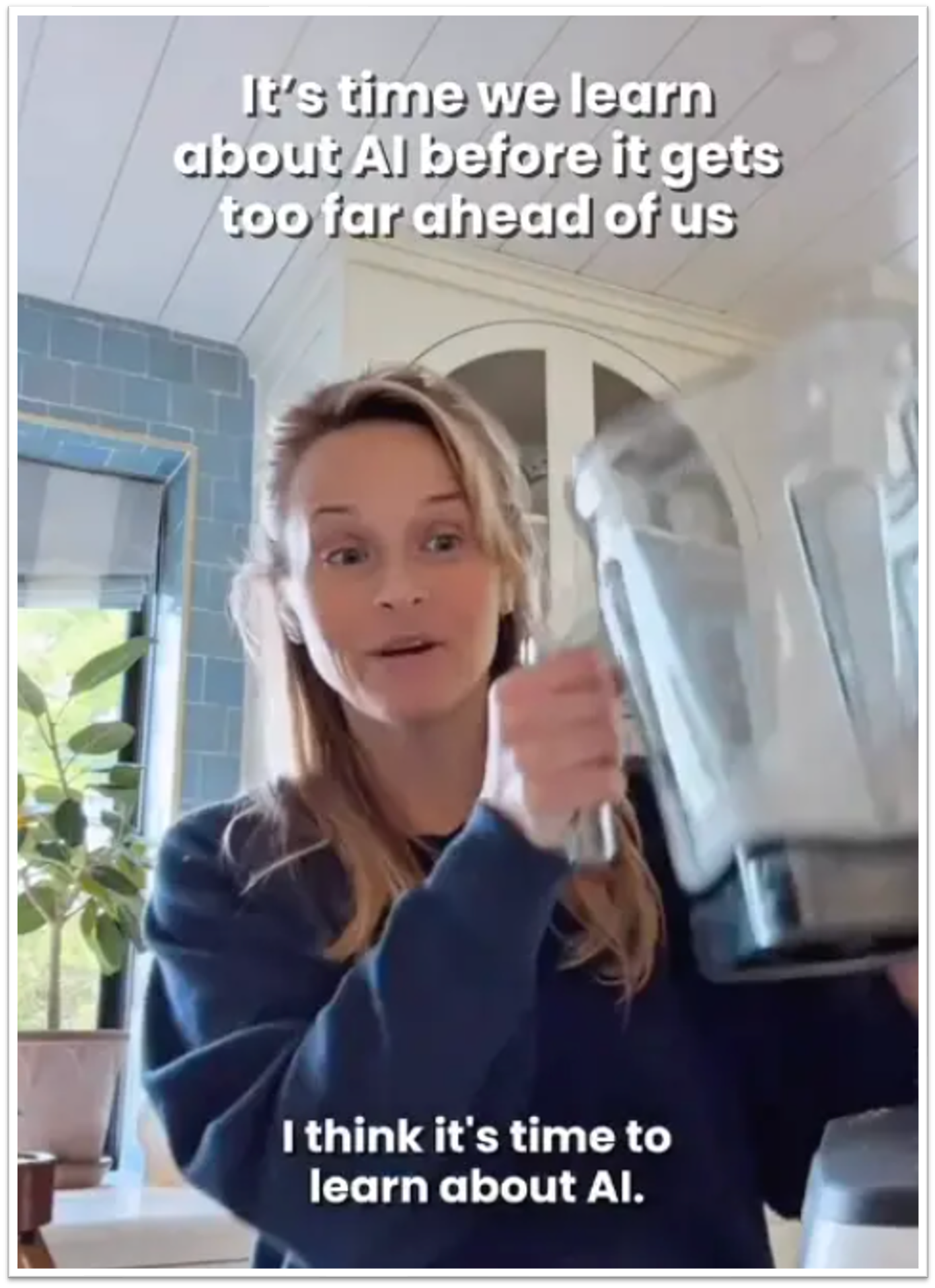
Reese Witherspoon stood in her kitchen casually blending a smoothie and told her 30 million Instagram followers that women need to catch up to AI. Mel Robbins did a sponsored Reel for Microsoft Copilot. Sheryl Sandberg announced her organization would focus on closing the “AI gender gap.” The Cut just published a piece calling it The Girlbossification of AI. The internet went wild, calling them sellouts, grifters, girlbosses shilling for technocrat bros. I can see where parts of the criticism is fair, but somewhere in all the noise, the actual argument got lost among the women attacking other women. Again.
I kept thinking about my mother.
For a decade, she refused to learn how to use a smartphone. She wore her internet indifference like a badge of honor. I tried to warn her; she shrugged. Then, quietly, she started to realize what was happening: she was being left out of the family chats, missing the inside jokes, the photos, the plans made in real time. Her friends were on WhatsApp. Her grandchildren were sending voice memos and the photos she cherished in a device she didn’t know how to use. The culture of everyday connection had moved to a world she refused to join.
So her world shrank while everyone else’s expanded.
She eventually learned WhatsApp, but by the time she came around, she had missed out on a lot. And the learning curve to adopt this technology was way higher than if she had learned all the concepts from the beginning stages of the smart phone.
We are living through a technological shift that makes the smartphone revolution look pedestrian, and women are, once again, at risk of being the ones who wait too long. Listen, I’m not saying AI is benign. But I’m asking you to think very carefully about what it means not to learn and understand this technology as it quantum leaps forward into who knows where.
Should we learn AI out of fear? No. Should we jump on the bandwagon just because men are there? Also no. Learning AI doesn’t mean losing half your brain or surrendering your values. It means incrementally learning and using the technology because this is the world is going, like it or not. And I’m not talking about basic Chat GPT. I’m talking about sharing this space with men in the highest levels.
The Numbers Don’t Lie: Women Will Be the Most Affected.
The data on women and AI is sobering.
33.7% of women work in roles being disrupted by AI vs. 25.5% of men (WEF/LinkedIn, 2025)
86% of workers both highly exposed to AI job loss and least able to adapt are women (Washington Post / UC Berkeley Haas, 2026)
Let that last number sink in: 86%. Women are disproportionately concentrated in the roles AI is designed to replace first: administrative assistants, customer service, data entry, paralegal support. These are not niche jobs. These are the jobs millions of women have built their livelihoods on.
Meanwhile, men use AI daily at a rate 22% higher than women. Men are 27% more likely to have been praised for using AI at work. Men are 23% more likely to receive manager encouragement to adopt it.
The gap is not just about who’s using AI. It’s about who’s being supported, rewarded, and positioned to lead through it. And the more we refuse to learn it, the further away we are from the job market and the every day realities that will become more dependent on AI.
NEWSFLASH: The Genie Is Not Going Back in the Bottle
All the reaction about resisting and denying a world with AI would be valid if AI were reversible. It is not. The train has left the station. Are we going to be delusional enough to think we can stop it, or are we going to face reality and do something about it?
This technology will not be uninvented. It will not be regulated back to irrelevance. If women get involved, it can be regulated into something more equitable. But no amount of collective outrage, boycotts, or refusal to engage will return us to 2022.
The question of whether AI should exist is no longer on the table. The only questions left are: who will shape it, who will benefit from it, and how many people will be flattened by it.
Why Can’t Women Do Both?
We can fight for rigorous regulation, limitations for children and young adults, and copyright protection AND learn to use these tools. We can demand responsible environmental practices from companies building data centers AND build skills that keep us employed. We can push for diverse representation in AI development AND show up in rooms where AI decisions are being made. These are not contradictory positions — treating them as if they are is a false choice that only serves the people who would profit when we are out of the conversation.
The most powerful thing a woman can do right now is understand AI well enough to fight it intelligently, use it strategically, and influence it at the highest levels. And don’t forget: enjoy its benefits too.
I think this is very similar (but way more dangerous) to voting. Nobody in the US is legally required to cast a ballot. You can opt out, decide the whole system is corrupt, and that you can’t possibly partake in something so imperfect. And maybe you’re right about all of it. But you don’t get to then complain about who’s in office. You don’t get to be shocked by the policies, the appointments, the direction of the country because you handed that decision to someone else.
Black women have understood this better than anyone. Election after election, they have shown up at rates that shame every other demographic — and they have, more than once, single-handedly determined the outcome of races that shaped this country’s future. Not because the system was built for them. but because they understood that absence is also a choice, and that choice has consequences.
My prediction is that AI is going to pan out exactly the same way. If women opt out — of learning it, building it, regulating it, funding it — the decisions will get made without us. And we will have handed that power to someone else. We already know who that someone else is.
Yes, the environmental damage is horrible and real. The labor displacement, the data bias are real. But women who opt out of understanding this technology will not be the ones shaping the regulations, auditing the bias, or sitting in the rooms where the guardrails get set.
I am not telling you to upload your financials to a chatbot because a celebrity told you to. Understanding a technology and endorsing it are not the same thing. The most effective critics of AI are the people who understand it well enough to know what questions to ask and what regulations to demand.
I saw people complaining we are just funding the AI bros - well, if there were women in this space, we would be actually funding women and I bet the landscape would look different. But that will require women to participate and want to lead the way in AI. Sitting on our hands will just make things worse, and being shamed by other women definitely won’t help matters.
The Real Dangers (And the Real Possibilities)

The AI Bias
AI systems are not neutral. They are trained on historical data, and historical data reflects historical inequalities. AI systems evaluating leadership potential score female managers 25% lower than men with identical qualifications. Internal promotion algorithms recommend women for advancement 15% less frequently. A Harvard Business Review study found that female engineers using AI to generate code were rated nearly 9% less competent than male counterparts — despite identical outputs. AI pregnancy monitoring systems miss 30% more complications for women of color due to gaps in training data. This is not a bug. It is a reflection of whose experiences were centered when these systems were built.
The builders matter. Only 22% of AI professionals globally are women. Less than 18% of AI researchers are women. When the people designing these systems don’t include you, the systems will not be built for you. And do we think the answer is to let the men keep conducting this bullet train?
What AI Can Do For Us
The same technology threatening to displace women is being used by women who’ve decided to engage on their own terms: streamlining administrative work to reclaim time for strategy; compressing days of research into hours; enabling small business owners to compete with capabilities once reserved for large enterprises. A survey of over 1,300 developers across 61 countries found that 64% of female developers say AI is accelerating their careers. When women engage with AI, they gain from it. The question is who gets to shape AI — and who gets left behind while it’s being shaped without them.
Men Are Accumulating All the Wealth. Again. Is That What We Want?
In 2025, billionaire wealth reached $16.1 trillion. The single largest sector was Technology at $5.2 trillion, driven by AI-fueled valuations. The people accumulating that wealth are, overwhelmingly, a very small group of men.
Eliminating gender bias in AI, the World Economic Forum estimates, could add $12 trillion to global GDP. Women’s participation in AI is an economic imperative. But that argument requires women to be in the conversation. And some people may say “why does everything have to be about money?”. Well, it doesn’t. But so long money exists, people will derive power from it, and we need to decide if we want more of the pie, or if we will just let men accumulate all the wealth. And power.
It’s Groundhog Day for Women
The internet felt like a fad. Then it reorganized the economy. Email and internet felt optional until not having it became professionally disqualifying. Smartphones seemed a luxury until they were a necessity. We are at that inflection point again.
If AI reshapes the labor market the way its advocates claim — and the data suggests it will — women without AI literacy and parallel income streams will be the most economically vulnerable. Opting out for moral reasons is not a privilege most of us will have.
Moving Atoms
Maybe I’m wrong about all of this. Maybe the pendulum swings back. Maybe we return to making things with our hands — farming, crafting, building, creating in ways that require a human body and a human soul. Elon Musk — I know, problematic messenger, but not entirely wrong observation — once said that jobs which “move atoms” will be the hardest for AI to replace. The carpenter, the chef, the plumber, the farmer, the nurse who holds your hand. Maybe the antidote to the algorithm is the profoundly, irreducibly physical.
I hope some version of that is true.
But isn’t the best way to defeat something to learn how it operates and dismantle it from the inside?
The people who will shape AI regulation are the ones who understand AI. The people who will catch its biases are the ones running its tools. The people who will build something better are the ones who refused to leave the room.
And by the way: if you are against AI, does it mean by “opting out” that you will also forgo its benefits? If there is a cure for cancer through AI, will you refuse it?
I don’t know how this ends. Nobody does. But I’m not sitting this one out.
And I hope you don’t either. Sending love,
Patricia
Yes! I began playing around w/Claude over the winter which led to me getting certificates in various Anthropic courses. I know there are HUGE environmental concerns no but.
What I have learned is that AI levels the playing field is so many ways. I will be writing about it as well. I am joining you on this journey
How do I begin to learn AI??