

* If you prefer audio, you can listen to this newsletter on Substack. Just find the play button on the top right corner.
Hi there,
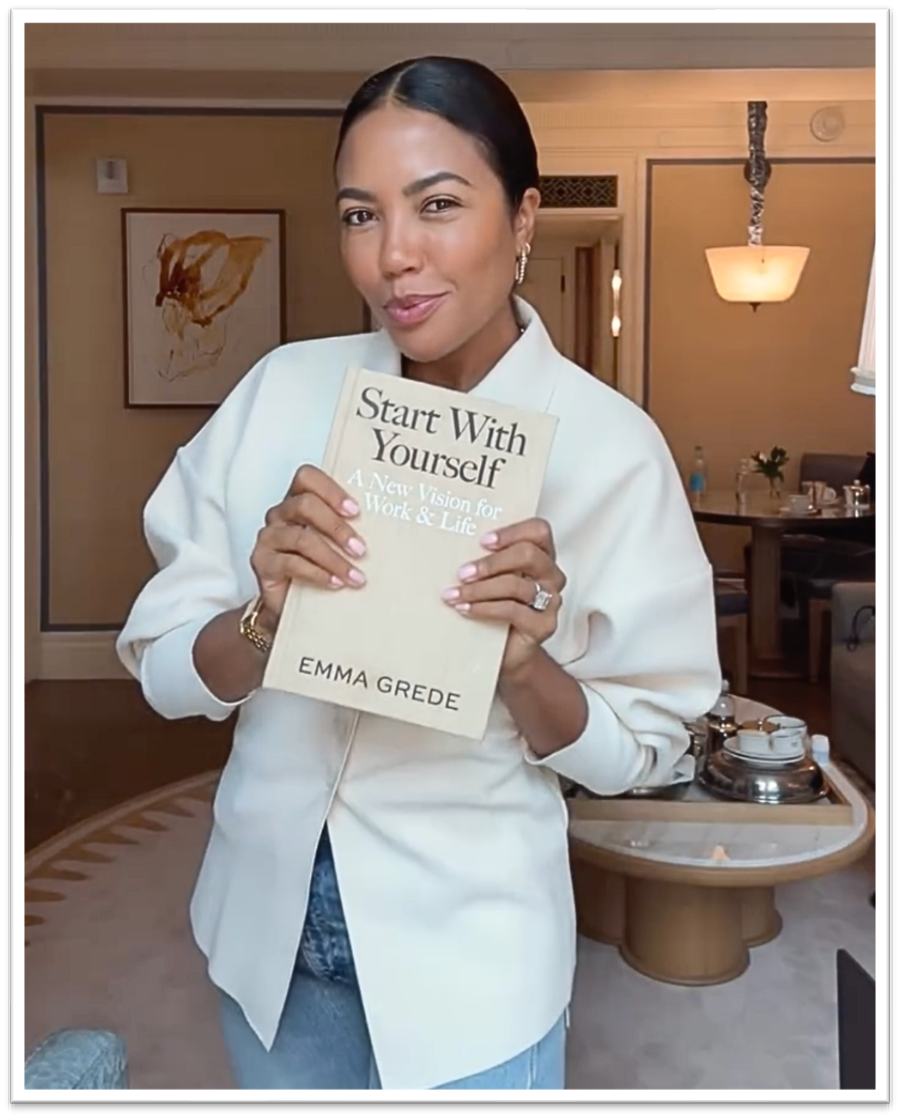
If you’ve been anywhere near the internet this week, you’ve heard about Emma Grede’s book “Start With Yourself”, and the firestorm around her comments about working from home and spending three hours a day with her children. I have thoughts about that, and I may share them one day, but I didn’t want to wait another minute to talk about what it’s the most universal and urgent part of her book: the chapter on money.
Buried inside what is technically a business book is the most urgent chapter every woman needs to read. Stay-at-home mom, entrepreneurs, women in corporate careers, all of the above, or none of the above — the way Emma has learned to think about money, how she navigates the world, and her energy and passion for taking responsibility for her own fate are stunning lessons every single one of us can benefit from.
I honestly wasn’t expecting to be so taken by her. Of course I knew she is smart and charismatic, but I didn’t expect to appreciate this woman so much for her candor and mental strength. This woman is a force. I listened to the audiobook, and Emma speaks the way she apparently lives: with urgency, without apology, and without the polite hedging most of us have been trained to perform around money.
This is not the first time I’ve raised my voice about this. Some of you have been here long enough to remember when I recorded a podcast called WEALTHY specifically to talk to women about what they do and how they do it — and I ended every single conversation with the same question: Did you talk about money growing up? The answers were almost always the same. No.
Money is vital for everyone, and understanding our relationship with it — and actively working to change it — cannot wait. Whether you like Emma or not, or if you support her businesses or not, is not the point. Go buy the book, if only to read this part. It’s Track 14 on the audiobook on Spotify. 😊 My hardcopy in in the mail, and I’ll like to keep it on my desk. Now here are my biggest takeaways from what Emma wrote.


1. The Silence Is Costing Us
I loved how Emma explains this issue of silence because it’s true everywhere.
Despite running her own podcast and interviewing some of the most powerful women in business, she can’t get her female guests to speak candidly about capital raises, compensation, or deal structures — even off the mic.
Then she interviews Michael Rubin (founder of Fanatics, a $30 billion business), and when she asks him every money question, he answers them all, with zero shame or anxiety.
Often times women feel that talking about money is not elegant. Emma’s response is pure gold: “When we feel like it’s inelegant to talk about money, money has a way of elegantly passing us by.”
Elegance is buying your first house. Elegance is traveling on your own dime. Elegance is not having to ask anyone for permission to make a decision about your own life.

2. Money Is Not the Enemy
Emma is direct about something many women I know still resist hearing: money is neutral, and it’s foundational. Money buys space, ease, convenience, support, security, and access to opportunity. You can be a deeply ethical person and earn exceptionally well. You can care about the world and insist on being paid what you are worth. You can create culturally meaningful work and be compensated generously for it. These are not competing values, and liking money doesn’t make you a bad person.

3. Find Your Money Story + Stop Avoiding Money
I think most women already know this. Many of us arrive at adulthood carrying a distorted relationship with money, shaped by how our families talked about it (or didn’t). What did money mean in your house growing up? Was it discussed openly or hidden? Was it a source of conflict, of anxiety, of silence? Because whatever the answer is, it’s still shaping your decisions today.
Emma traces her own financial clarity back to her mother, who sat at the kitchen table every month, wrote the checks, balanced the accounts, and treated the bills as a basic reality of life, not a source of shame or something to avoid. She contrasts this with daughters of other single mothers whose mothers would stuff bills in the couch cushions or throw them away unopened because they couldn’t bring themselves to look. She calls for exposure therapy: think about money constantly, look at it directly, and stop turning away. I think that’s a great idea.
4. Scarcity Is a Magic Trick
One of Emma’s most powerful arguments is that scarcity — the feeling that there is only so much to go around, that if she gets more you get less — is largely engineered. It’s a made up story that disproportionately traps women.
She hears male colleagues and bankers openly sharing deal structures, and pay packages. They see other men succeeding and think: if him, why not me?
And women are fed a constant message that it’s winner-take-all. That there is one seat at the table, one shot, one window. And because we have so few visible models of success, we believe it.
Men look around and see a world built for them, with examples of men thriving in every industry, and they move through their careers with a baseline assumption of possibility. Women look around and see scarcity, we see limitation and competition with each other rather than opportunity alongside each other.
Get out of your scarcity mindset and stop accepting the terms of a game designed to keep you distracted from your own value.
5. Stop Being The Last Person You Advocate For
Every time HR comes to Emma needing sign-off to exceed a salary band, it’s always because a man negotiated his way up to her. The women, with rare exceptions, accepted what they were offered.
Her negotiation framework is blunt and I love her for it: assume you are being paid less than you are worth and ask for more. Don’t over-explain and state the ask, never take the first offer, and most urgently: strip the language of pre-emptive defeat from your communications. I am guilty as anyone in doing this: No worries if this doesn’t work. This is of course negotiable. Sorry to bother you. Every time you write those words you are negotiating against yourself before the other person has said a word. Practice saying what you mean without the cushion. It gets easier, but only if you practice.

6. What Emma Is Asking You to Do — And I Co-Sign It!
Emma ends her chapter section with a direct call to action, and I want to add my name to every word of it.
Talk about money — openly, with your friends, your colleagues, your daughters. Don’t let anyone make you feel that caring about your financial security makes you less refined, less spiritual, less good.
Learn your own finances. Understand your mortgage rate, your retirement accounts, your investment vehicles. Don’t outsource your financial literacy to a partner, a parent, or an advisor without insisting on understanding every decision being made on your behalf. What Emma said about her husband is a mic crop in itself: She said she trusts her husband completely because knowing where you stand takes the stress of dependence out of the equation entirely. This is an incredible way to see financial independence inside of a relationship.
Find out what your work is worth in the market, and then share that information with other women, with full details intact. This is one of the most direct, immediate things we can do for each other. Men do this constantly. We can too.
Make introductions to your accountants, bankers, and lawyers. These networks are currency, so share them often.
Know your value. State it without apology.
Make a financial plan. Now.
Sending love,
Patricia
I'm thrilled you focused on Emma's stance on money (although I can't wait to hear how you feel about the 3-hour-kid-window). You're both so right re: our money stories. As you know, I'm living my own story of waiting to being saved and the consequences. This reminds me of another rescue fantasy that prevents women from owning their own financial/professional authority - waiting to be "discovered" (on the rise with the proliferation of Instagram). Love that Emma's book is generating so much discussion and that you brought it to the table here!